Monday, July 19, 2010

Yes, South Africa can!!

July 10 2010 at 08:24AM By John Carlin


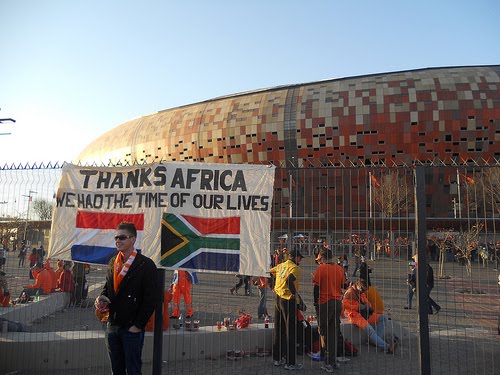
It's been a spectacular success. Everything according to plan, smooth as silk; South Africa successfully re-branded; no unpleasant surprises, and plenty of pleasant ones.


Not a cheep, for example, out of the ludicrous Julius Malema, who the ANC wisely loc
ked up in the attic, as you do with the mad live-in relative when important guests come around.
No reports of any new Zuma off-spring, or even wife. As for the bigger and far more important picture, the games all started on time and were broadcast live around the world without a hitch (though I gather there were some power-cut problems in England "mercifully, perhaps" during one of their national team's relentlessly hapless displays). No massacres of foreign visitors, either, as long advertised in the foreign press.Crime generally seems to have sunk to Swiss levels of innocuousness during South Africa's four-week World Cup honeymoon.

Archbishop Desmond Tutu famously declared on April 27, 1994, the day all South Africans went to vote for the first time: "It's like falling in love!" Well, 16 years later, it was a renewal of the marriage vows; it was South Africa falling in love with itself all over again.
All those stories, promoted by Fifa, among others, about this being Invictus II, about 2010 being the 1995 rugby World Cup all over again, about healing racial wounds, uniting the fractured nation and so forth, were off the mark. It was much, much better than that.
What we saw was just how united and
racially healed South Africa really is, how far we've advanced since the nervy Nineties 1990s. The word for what we have seen in these past few weeks is consolidation. Nothing new, these past years, to anyone who has walked about South Africa, done ordinary everyday things, in seeing black and white people getting along just fine.
All the racial tension stories that surfaced after the death of Eugene Terre'Blanche ("South Africa on the brink of racial war" etc), ha
ve been shown to be, as a British friend of mine who knows the country well, succinctly put it the other day, "just so much bollocks".

I've been to watch
loads of games at the stadiums, but by far the best memory I take away from the World Cup was the atmosphere at Melrose Arch, in Joburg, during the South Africa-France game. From what I saw there, and from reports of friends and fellow journalists who have taken part in identically joyous events of this kind up and down the country, I'd like to ask a question: "If South Africa is not a united country, then what country is?"
As I have written in these pages
before, the thousands gathered before a big screen at Melrose to watch Bafana Bafana's heroic exit from the competition knew in their hearts that it was a lost cause, that their team would not make it to the second round of the competition. But the solidarity was absolute. People of all colours and religions, in what until not very long ago had been an exclusively white residential area, heaving and swaying and singing, celebrating their common South Africanness with proud, unforced energy: what a blow for the legion of dismal sceptics that flood the opinion pages of this country's newspapers!

Never mind black and white, there were a number of Jewish people with yarmulkes on their heads at Melrose and a number of Muslim men with long beards and Muslim women we
aring veils on their heads. Where else in the world would you see such people mingling without tension, their national identities trumping ancient religious divides? Not too many places, believe me.
And the great thing is that the world has got to see all this the rebranding really has kicked in.
Via 15 000 fellow journalists that have descended on this country (please, don't anyone tell me ever again that the World Cup was a waste of money!), the entire planet has got to see South Africa's best face - in my prejudiced view, the best face in the world.

I have spoken in the past four
weeks to journalists from Mexico, El Salvador, the USA US, China, India, Britain, Germany, Spain - you name it. The first thing that has has surprised them has been the total absence of racial friction. Most of them being white, or white-ish, they concurred that the contacts they had had with black South Africans had been consistently civil, cordial, respectful, good-humoured, even fun.
As for the the panic in their hearts at the prospect of murderous hordes chasing them down dark alleys, the predominant sensation among those who acknowledged they had succumbed to these terrors was embarrassment.

I did a bit of work early on in the competition for a big US television channel, some on-air punditry about South African politics and society. The recording studio was at Nelson Mandela Square in Sandton, just above the big statue of the great
man. About 100m away was the television station's tented base of operations.
I and an American producer walked from the studio to the base camp and back half a dozen times. Our trajectory was through a crowded
mall. The only potential peril I was aware of was that we might trip on the mechanical escalators and bang our heads.

But you know what? The television station's rules required that on each of these strolls we should be accompanied by a beefy security guard - a dark-suited Nigerian, in this case. The producer I was with honourably squirmed at the timorousness of his
employers. The Nigerian kept a poker-face, but inside he was laughing, all the way to the bank.
Worse was the case of the Englis
h journalists covering the England camp. The bus they travelled in always had one security escort in front and one behind; four Afrikaner former police officers or soldiers kept watch on them everywhere they went.
At first the journalists were not displeased to have them around. I heard that before the World Cup the bosses of one major British newspaper (won't tell which, but it wrote about the looming racial bloodbath following Terre'Blanche's death) had the brilliant idea, in these troubled economic times, of hiring a security consultant to address
the South Africa-bound troops.

A man with a briefcase appeared (presumably working for the same outfit that would later provide the detachment in South Africa) and rattled off the figures for violent crime in the purportedly benighted country, for murder, for rape - not excluding male rape. He put the fear of Go
d into the poor journalists. Four weeks later what they feel is deeply embarrassed.
Talking of journalists, on a less fool
ish note, the way Fifa and the Local Organising Committee set up the bureaucracy of accreditation and general facilities was a dream.
Cleverly aware of how critical we often unsavory characters would prove in the marketing of South Africa, they set up a wonderfully
smooth operation.

Getting your tickets for games was straightforward and the staff were as cheerful as they were efficient. At the stadium media centres and the press seats the internet connections (journalists' lifeblood these days) were excellent, whether you were in Rustenburg, Bloemfontein or Joburg's Soccer City.
I covered the World Cup in Japan in 2002: this was incomparably more hassle-free. I heard the same from journalists who covered the World C
up in Germany four years ago.

Oh, and let's not forget the Fan Walk in Cape Town, a two and a half kilometre 2.5km vaudeville show from the centre of town to that beautifully elegant Coco Chanel hat of a stadium, along which the massed hordes, thousands of children included, were bursting with bonhomie - so much so that for the semi-final on Saturday the love in the air breathed unexpected life into the sails of old Holland.
The long-buried historical connection with the Dutch (Jan van
Who?) suddenly surfaced in the Mother City in a riot of orange. I went up to one orangeman and woman after another, a number flying Dutch flags, and, to my astonishment, all the ones I spoke to turned out to be South Africans.
They were happy Holland won, not least because they avenged Uruguay's unspeakably cruel victory over Ghana. But what they were happiest about was, I think, that they had recla
imed the streets. Save for the odd case of pickpocketing (you get them in Vienna), nothing to fear.

I have a theory - I actually had it, rather more wishfully, before the World Cup - that the criminal classes would go on a patriotic strike during the tournament, doing their bit for Brand SA.
Whether that was it, or whether it was a pragmatic calculation that what with the
emergence of these swift and severe World Cup courts and the flooding of World Cup venues with the men and women in blue it might be best to keep their heads down, the fact is that the country has been more relaxed and at peace than it has been for a long time - maybe ever.

Actually, to be seriou
s, huge credit has to be given to the police. I came across loads all over the country and they were, without exception, polite and efficient, oozing civic responsibility. One that I met off duty in a bar in Bloemfontein sang me a symphony of racial brotherhood, banging on - in his cups, a little - about how South Africa was a piano. The black and white keys had to play together, he said, or not at all.
Obviously we'll have to see if all this lasts after the World Cup is over. Enough people have vented their views on this already and there is not much more to add.


Though it will be intriguing to see if the police turn out to be as assiduous in protecting the foreign Africans here, against whom murder and mayhem is threatened (especially in jolly old Cape Town), after the final whistle blows on Sunday night, as they have be
en in keeping the rather more welcome World Cup visitors safe. We'll have a test case right there of whether it's all been a dream or not.
Which brings us to the first lesson of this World Cup: the primary purpose of government is to protect its citizens. Well, let's absorb that thought and act on it. Sustain the good work that's been done after the show is over and watch this country go.

The second lesson, not at all unrelated to crime, is that if South Africa really puts its mind to something, it can do it, it can make a plan. Fifa has got a pretty bum rap from people in this country for its autocratic ways, but the Swiss-Germanic rigour that's flowed from Zurich has definitely sharpened up levels of efficiency and organisation round here, not to say - the big South African "d" word - of delivery.
Someone who works high up in the Local Organising Committee told me how at first it had been a big culture shock to work with these Swiss; they did not understand each other at all. But in time they established a rapport and the fusing of African ebullience with old European discipline ended up doing the job admirably.

The big lesson I take away from all this is one that I already knew but had forgotten, amidst the distracting babble we read about in the press and , hear and see in the broadcast media from the political classes, chatterers and newspaper columnists.

South Africa is much better, brighter and bigger-hearted than you'd think from paying attention to all that lot. The society is great, and it is the reason why (never mind the safari parks and the fairest Cape) so many of us foreigners who've spent time here find this country more beguiling than any other on Earth. Ordinary people have so much more wisdom, grit, resilience, invention, courage and generosity than you find in most countries.

And some of these ordinary people are to be found, for sure, in the ANC. Even in the upper reaches of the government, if you look hard enough. There are the looters, the hypocrites and the frauds, too, as we all know. We can just hope that the experience of the World Cup might have awoken their better angels, brought out the good that lurks in many of them, that sparked their commitment to politics in the first place.

Failing that, as a friend here says, let's pray that they remain content with taking just five or 10 percent of the national cake, instead of 30 percent or the full damn monty.

Your Julius Malemas - and I use him as a generic term for all that's rotten and silly about the South African political scene - are best ignored. Or rather, friends in the media, try, if you can resist the temptation,
not to publish and broadcast what he says. Delve deep, rather, into what he and his like do.
As for Zuma, he is a nice guy and has many of the best instincts of the best South Africa. The problem is that he lacks
gumption and sexual maturity. Not much we can do about the latter, but maybe we can prod him to show a bit of principle and character and lead the ANC back to what it once was, abandoning its lootocratic ways. A leader must not be a jellyfish, said PW Botha. Heed those words, Mr President.

Though, perhaps, he won't. In which case, let's take comfort in the knowledge that the country is, I repeat, bigger and better than the state.

If the state does not get in the way, if it actually helps, as it has done with this World Cup (notably the policing, but also the building of infrastructure) then great.
If not, well, South Africans have it in them to make a plan. The big message from this spectacularly successful staging of the greatest show on Earth is that, yes, South Africa can.
Now, with more confidence and pride and calm than ever before, get on and do it.

* John Carlin was the correspondent for the London Independent in South Africa between 1989 and 1995. He has returned to South Africa frequently since then, including nine times in the past 18 months, chiefly to work on television documentaries. He wrote Playing the Enemy, the book on which the Clint Eastwood film, Invictus, is based. The book has been translated into 16 languages, including Spanish and Dutch.

Photo Credits: http://www.shine2010.co.za


Thursday, July 8, 2010

Cape Town does it again!

Cape Town has once again made it onto another global list for its exceptional beauty. This time, Forbes magazine has named Cape Town one of the twelve most beautiful cities in the world.

The Forbes list, released earlier this year, puts the Mother City on a par with Paris, Vancouver, Sydney, Florence, Venice, San Francisco, Chicago, New York City, Cambridge, Tokyo and London.

Cape Town is the only city from a developing nation to have made the cut, and the only one on the African continent.

Forbes was particularly impressed by Cape Town’s open spaces. According to environmental engineer Raymond Levitt, the city was also singled out for its small ecological footprint compared to sprawling metropolises like Tokyo and New York.

The list is drawn up in consultation with experts from a range of relevant fields, including architecture, urban planning and sustainable development.

These experts included Amanda Reynolds of the UK-based Urban Design Group, architect Michael Kaufman of Goettsch Partners in Chicago, and Raymond Levitt, professor of civil and environmental engineering at Stanford University. UK urban designer and architect Tony McGuirk, J Hugh O'Donnell, CEO of engineering firm MMM International, and Ken Drucker of the New York office of architectural firm HOK also provided input.

The view of Cape Town from the Table Mountain cable car station .A 2010 Fifa World Cup host city, Cape Town is gearing up for the tourist influx with a host of infrastructure upgrades, such as the Integrated Rapid Transit system and the impressive new Cape Town stadium and its associated Green Point Common, which is being developed now that the stadium is fully functional. The common is expected to become an important social gathering site once complete.

Cape Town also hosts a number of other popular sporting events, such as the annual Cape Argus and Cape Epic cycle tours and the Two Oceans ultramarathon. Participants from all over the world descend on the city to pit their skills and endurance against the best athletes in these taxing sporting disciplines.

Renowned English sea navigator Sir Francis Drake once referred to Cape Town as the fairest cape in the world. The city has an abundance of unspoilt beaches and is home to one of South Africa's most famous landmarks, Table Mountain.

The mountain is part of the 30 000ha Table Mountain National Park, administered by South African National Parks, and is home to a wide range of animals and birds. The park is also popular with thrill-seekers who are able to hike, climb, cave, and base-jump from its many cliffs.

Further inland, the Cape winelands offer award-winning wines from many world-renowned estates, some of them possessing an ancestry that dates right back to the early days of the Cape’s colonisation by the Dutch.

Cape Town is also known for its bustling nightlife, highly rated hotels and fine restaurants. Some of the top establishments in the country are to be found here, a number of which have also won international acclaim.

To view the full list, go to www.forbes.com

Let's blow our vuvuzelas for a bright South African future
by Boris Johnson, Mayor of London
Telegraph.co.za published 20 June 2010

I wish you could have come with me yesterday as I ran through the delightful district of Westcliff, one of the richest square miles in Africa. The sun was taking the chill off the winter morning. The sky was blue. The urban forest of Johannesburg was a winter symphony of brown and green and gold.
Among the trees, on either side of the well-kept street, I passed the kinds of homes you normally associate with Beverly Hills. Here was the honey-stoned palazzo of a diamond executive. There was the schloss of the most successful boob-job exponent in the neighbourhood.
Each villa was the size of a country club, and through every set of gates you could see the carob-shaded tennis court or the ultramarine ping of the sunlight on the pool. Every property overtly proclaimed the determination of the haves to resist the depredations of the have-nots. Great brown Rhodesian ridgebacks snuffled behind the electric fences. Chubb security vans cruised quietly up and down. Fixed to the wall beside virtually every nine-foot impregnable gate was a sign announcing that any intruder would be met with an "Armed Response".
I wish you could have been there, to soak up the splendour of the lives of the affluent Johannesburg professionals. Then I wish you could have come with me to another neighbourhood, a township called Cape Flats, nor far from Cape Town. Then you would have understood the vast economic disparity of South Africa – the wealth gap that helps to prompt the security fences of Westcliff.
Here there was no tarmac on the streets. No one had cleared up the piles of rubbish. No one had painted the battered grey breeze blocks of the flats or mended the panes in the washing-hung windows. Of the hordes of unwashed kids who came out to compete for our presents – badges and trinkets – hardly any seemed fluent in English.
A nice one-eyed woman called Mary took us in to see her flat, and though she was immensely proud of her two chipped-eared china dogs, and though her lino floor shone with mopping, she had almost none of the amenities that are taken for granted by the poorest families in modern Britain.
She had no hot water. She had no cooker except for a couple of electric rings. She had no system of heating or air conditioning, and though Mary and her family were avidly following the World Cup, they were listening to the commentary on a crackling old radio. They had no television, and nor did any of the neighbours. Above all, she had no job, and neither did her husband. It was years since he had last worked as an upholsterer for motor cars, and the same applied to all the hundreds of other men and women who swarmed out of their flats to welcome the delegation from London. They had no job, and no hope of a job – and yet these people, Mary and her neighbours, were lucky by the standards of many in South Africa. Mary lives in breeze-block luxury compared with the inhabitants of the "informal settlements" – shantytowns to you and me – of which there are 230 in the vicinity of Cape Town alone, providing homes to about 500,000 people in a population of 3.5 million.

It is when you have such inequality, and such grinding poverty, you cannot be surprised that some pessimists have asked whether it was sensible for South Africa to take on the difficulty and expense of hosting the World Cup. That is why I have spent the past few days posing the legacy question to just about everyone I have met.
What happens on July 12, after the captain of the winning team has waved the Jules Rimet trophy in his sweaty palm? What will people say when the last fan has traipsed home and the last journalist has composed his last philippic against his defeated national team and when the last vuvuzela has parped its last melancholy parp? What will this World Cup leave for South Africa? I have asked barmen and journalists and politicians such as the remarkable Helen Zille, premier of the Western Cape province. I have ended up feeling like those Monty Python characters who were so foolish as to question the benefits of the Roman Empire. The World Cup not only gave jobs and skills and hope to thousands of local people.

The tournament gave an absolute deadline to South Africa for the introduction and improvement of all kinds of infrastructure – not just sports grounds, but roads and bridges and airports and bus lanes that would otherwise not have been built and which will benefit the country for decades to come. Above all, the World Cup has given this country something intangible but priceless: a deep sense of pride that it has taken on something difficult and done it well.
When they look at themselves in the approving mirror of world opinion, South Africans of every race agree that the first African World Cup is a joyous success, and that success breeds confidence. The rand is rising. South Africans who left for Australia or Canada are starting to return to a country whose banking system largely escaped the recent crisis.
The sheer number of visitors – about half a million – will help to open the eyes of the world to South Africa and its potential for trade and investment; and get this – crime, the crime that has been supposed to be one of the drawbacks of living here, is down 90 per cent in central Cape Town, and there has not been a single serious incident of crime or violence in any of the fan parks.
Of course there will be disappointments, and no one could pretend that the World Cup will solve the economic or political problems of the country. But it offers a sense of unity and confidence to a place with a tragic past. It should help to build the taxpayer base that is so essential to narrowing the wealth gap. It gives potential wealth creators at least some of the infrastructure they need.
Fifa took an inspired decision to give the World Cup to South Africa, and South Africa has responded brilliantly.


Wednesday, June 23, 2010

Trying to Capture the Flavor of South Africa
New York Times June 23, 2010, 12:09 am  By JIM LUTTRELL

There has been the constant drone of the vuvuzelas and pictures of elephants blocking traffic, but one Arizona restaurateur wanted to capture a little more of what he thought was the atmosphere in South Africa. This from the Associated Press:

An Arizona restaurant owner dreamed up a novelty meal to give customers a South African experience during the World Cup. But serving burgers made with African lion meat has generated protests.Cameron Selogie said his Il Vinaio restaurant in Mesa has received a bomb threat and more than 150 e-mails from protesters. He said African lions are on the protected list, but are not endangered.
The restaurant ordered 10 pounds of African lion meat from a U.S.D.A.-regulated, free-range farm in Illinois, which, Selogie said, he researched to make sure the farm was humane. The lion meat is mixed with ground beef, and the restaurant said it's serving about 15 burgers a day.
A U.S.D.A. spokesman said lion meat is an uncommon dish, but he knew of no prohibitions against it.

South Africa Rolls Out the Ubuntu in Abundance
The Huffington Post - Shari Cohen

International development worker in the public health sector

Posted: June 15, 2010 11:35 AM

I went on a rant the other day regarding the cost of the 2010 World Cup versus all the critical needs South Africa is facing and whether or not the most vulnerable of this country would gain anything from having the World Cup hosted in their country. At that time, I also had some very positive things to say about our hosts for the 2010 World Cup and I wanted to share that side of the coin as well, because it is equally important.

To say that I have been blown away at the hospitality South Africa has shown the rest of the world would be an understatement. I think back on recent Olympics and struggle to remember much reporting in the USA of athletes from other countries. I remember when a Togolese guy won a bronze medal in kayaking and NBC reported it and I thought to myself, "where are all the other fascinating stories like this one...like the Jamaican bobsledding team." In today's America, sadly, we have drifted so far towards being so US-centric that we only seem to root for the Americans.

Not so here in South Africa. I've been here since early May and each week I have become more and more impressed with the global embrace that South Africans have offered up to the world. On the way to the airport a couple of weeks ago, I heard a radio program that said each day they would focus on one country that would be coming to South Africa for the World Cup, and they would explore not only that sport's history in soccer, but also their politics, religion, and socio-cultural practices. On the television, I've seen numerous programs that focus on a particular country and it's history of soccer and how the history of that country is intertwined with their soccer history. I've seen programs on India, exploring why India enjoys soccer but hasn't really excelled at the global level... yet. And I've seen shows on soccer in Muslim countries. Maybe it's planned, maybe it's unplanned, maybe it's by chance, but it is happening. It's not just about South Africans showing off their varied and multifaceted culture to their global guests, it's also about using this opportunity to educate South Africa on the rest of Planet Earth's inhabitants.

As I moved through my work here in the provinces over the last six weeks, I had a pivotal meeting with the Board members of a rural NGO. They were explaining their guiding program philosophy of Ubuntu. No, not the Linux program. I'm talking about the traditional African philosophy of Ubuntu that essentially says, "No man is an island."

I found a better explanation from Wikipedia:

Archbishop Desmond Tutu further explained Ubuntu in 2008:

One of the sayings in our country is Ubuntu - the essence of being human. Ubuntu speaks particularly about the fact that you can't exist as a human being in isolation. It speaks about our interconnectedness. You can't be human all by yourself, and when you have this quality -- Ubuntu -- you are known for your generosity.


We think of ourselves far too frequently as just individuals, separated from one another, whereas you are connected and what you do affects the whole world. When you do well, it spreads out; it is for the whole of humanity.


To me, Ubuntu is the acceptance of others as parts of the sum total of each of us. And that is exactly what I have experienced during the lead up to, and the initial days of this World Cup. There is nary a South African citizen that I've met on the street, or in shops or restaurants or hotels, that hasn't gone out of their way to greet me and make me feel like I am home. And I don't mean that in the trivial, "Oh, aren't they nice, homey people here... " sort of way. I mean real, genuine interest and questions. People seriously want to know where I come from. What it's like where I live. How does it compare to where I am now. What do I think of South Africa. Oh yes, and what do I think of Bafana Bafana... The questions and conversations are in earnest. They are honest. And they are had with enthusiasm and a thirst to know more. South Africans are drinking deeply from the cup of humanity that has been brought to their doorstep. I would never imagine that an American World Cup or Olympics would ever be this welcoming to the rest of the world. And that saddens me for the state of my home country, but it also makes me feel the pride of the South African people.

I have been truly humbled on this trip. And while I have my gripes regarding development here, I cannot say one negative thing about how South Africa has handled its duties as host and hostess to the world. If I could say one thing to sum up being here during this once-in-a-lifetime experience, it would be that I've learned the value of Ubuntu, and that when found and offered in abundance, the world is indeed a better place to live in.

So, if South Africa accomplishes nothing more on the playing field, it will still have won as a host country. I am a cynic, no doubt about that. And yet I have to admit, I'm a little teary just writing this because I leave for home next weekend and I will be leaving a little piece of myself here in South Africa. I just hope I have learned enough to bring back a little piece of Ubuntu to my homeland, where perhaps with a little caring and a little water, it will take root as naturally as it does here, in the cradle of civilization. It's funny, many people in America still ask me, "are the people in Africa very primitive?" Yes, I know, amazing someone could ask that but they do. And when they do, I usually explain that living in a mud hut does not make one primitive, however, allowing kids to sell drugs to other kids and engage in drive-by killings -- isn't that primitive behavior? I think it is. When I think of Ubuntu and my recent experiences here, I think America has much to learn from Africa in general, in terms of living as a larger village; and as human beings who are all interconnected with each other, each of us having an affect on our brothers and sisters.

As the 2010 Cup slogan goes, "Feel it. It is here." Well, I have felt it, because I am here. Thank you South Africa, for giving me this unexpected gift. I am humbled.

Monday, June 14, 2010

Nice


 OPEN LETTER TO OUR FOREIGN MEDIA FRIENDS

by Peter Davies 09/06/2010 09:09


Dear World Cup visitors,


Now that you are safely in our country you are no doubt happily realising you are not in a war zone. This may be in stark contrast to what you have been bracing yourself for should you have listened to Uli Hoeness or are an avid reader of English tabloids, which as we all know are only good for wrapping fish 'n chips and advancing the careers of large-chested teens on page three.


As you emerge blinking from your luxury hotel room into our big blue winter skies, you will surely realise you are far more likely to be killed by kindness than by a stray bullet. Remember that most of the media reports you have read, which have informed your views on South Africa, will have been penned by your colleagues. And you know what journos are like, what with their earnest two thousand word opuses on the op-ed pages designed to fix this country's ills in a heartbeat. Based on exhaustive research over a three-day visit.


Funnily enough, we are well aware of the challenges we face as a nation and you will find that 95% of the population is singing from the same song-sheet in order to ensure we can live up to our own exacting expectations.


We are also here to look after you and show you a good time. Prepare to have your preconceived notions well and truly shattered.


For instance, you will find precious few rhinos loitering on street corners, we don't know a guy in Cairo named Dave just because we live in Johannesburg, and our stadiums are magnificent, world-class works of art.


Which is obviously news to the Sky TV sports anchor who this week remarked that Soccer City looked ' a bit of a mess'. She didn't realize the gaps in the calabash exterior are to allow in natural light and for illumination at night, and not the result of vandalism or negligence.


The fact that England, the nation which safely delivered Wembley Stadium two years past its due date, is prepared to offer us South Africans advice on stadium-readiness should not be surprising. The steadiest stream of World Cup misinformation has emanated from our mates the Brits over the past couple of years.


If it's not man-eating snakes lurking in Rooney's closet at the team's (allegedly half-built) Royal Bafokeng training base, then it's machete-wielding gangs roaming the suburbs in search of tattooed, overweight Dagenham dole-queuers to ransack and leave gurgling on the pavement.


In fact what you are entering is the world's most fascinating country, in my opinion. I'm pretty sure you will find that it functions far more smoothly, is heaps more friendly and offers plenty more diversions than you could possibly have imagined.


In addition to which, the population actually acts like human beings, and not like they are being controlled by sinister forces from above which turns them into bureaucratically-manipulated robots.


Plus we have world's most beautiful women. The best weather. Eight channels of SuperSport. Food and wine from the gods themselves. Wildlife galore. (Love the Dutch team's bus slogan: "Don't fear the Big 5; fear the Orange 11").


Having said all that, Jo'burg is undoubtedly one of the world's most dangerous cities. Just ask those Taiwanese tourists who got out of their hire car to take close-up snaps of tawny beasts at the Lion Park a few years back. Actually, ask what's left of them. And did you know the chances of being felled by cardiac arrest from devouring a mountain of meat at one of our world class restaurants has been statistically proven to be 33.3% higher in Jozi than in any other major urban centre not built upon a significant waterway? It's true. I swear. I read it in a British tabloid.


Having recently spent two years comfortably cocooned in small town America, I'm only too aware of how little much of the outside world knows about this country. The American channel I used to work for has a massive battalion of employees descending on World Cup country. It has also apparently issued a recommendation to its staff to stay in their hotels when not working.


Given that said corporation is headquartered in a small town which many say is "best viewed through the rear-view mirror", I find the recommendation, if it's true, to be utterly astounding. In fact I don't believe it is true. Contrary to the global stereotype, the best Americans are some of the sharpest people in the world. The fact they have bought most tickets in this World Cup proves the point.


Of course I have only lived in Johannesburg, city of terror and dread, virtually all my life, so don't have the in-depth knowledge of say, an English broadsheet journalist who has been in the country for the weekend, but nevertheless I will share some of my observations gleaned over the years.


Any foreign tourist or media representative who is worried about his safety in South Africa should have a word with the Lions rugby fans from last year, or the Barmy Army cricket supporters (lilywhite hecklers by day, slurring, lager-fuelled lobsters by night). They managed just fine, just like the hundreds of thousands of fans who have streamed into the country over the past fifteen years for various World Cups, Super 14 matches, TriNations tests and other international events. Negligible crime incidents involving said fans over said period of time.


Trivia question: which country has hosted the most global sporting events over the past decade and a half? You don't need me to answer that, do you?


In addition. Don't fret when you see a gaggle of freelance salesmen converge on your car at the traffic lights (or robots as we like to call them) festooned with products. You are not about to be hijacked. Here in Mzansi (nickname for SA) we do a lot of our purchasing at robots. Here you can stock up on flags, coat hangers, batteries, roses for the wife you forgot to kiss goodbye this morning and a whole host of useful merchandise.


Similarly, that guy who runs up as you park the rental car outside the pub intends no malice. He's your car guard. Give him a buck or two and your vehicle will be safe while you refuel for hours on our cheap, splendid beer. Unless someone breaks into it, of course.


We drive on the left in this country. Exercise caution when crossing the road at a jog-trot with 15 kilograms of camera gear on your back. Exercise common sense full stop. Nothing more. Nothing less. If you want to leave wads of cash in your hotel room like our Colombian friends, don't be surprised if it grows wings.


Bottomline. Get out there and breathe in great lusty lungfuls of this amazing nation. Tuck into our world-class food and wines. Disprove the adage that white men can't dance at our throbbing, vibrant night-clubs. Learn to say hello in all eleven official languages. Watch at least one game in a township. You will not be robbed and shot. You will be welcomed like a lost family member and looked after as if you are royalty. Ask those Bulls rugby fans who journeyed to Soweto recently.


With a dollop of the right attitude, this country will change your life.


It's Africa's time. Vacate your hotel room. Join the party.


Waka waka eh eh.


Tuesday, May 4, 2010

TU News : World Cup fun in the winelands

Hi

neil <stumble@iafrica.com> thought you may be interested in the content below.

message:

World Cup fun in the winelands

Vuvuzelas will meet fine wines and family fun when the 9th annual Stellenbosch Wine Festival kicks off a month earlier this year from July 1 to 5, offering football fans a wide range of 'off the pitch' activities.  
 
Visitors can park their cars at any of several park-and-ride areas in Stellenbosch and catch shuttles operating between the 140 participating wine farms. There will be also be transport from Cape Town, or visitors can drive there as well.
 
This year's programme includes day trips, interactive winemaking, restaurant and accommodation deals, wine tasting and exclusive winemaker dinners.
 
Wine farms getting into World Cup spirit are Delheim, Jordan Wine Estate and Webersburg, which will have big screens showing the soccer. Idiom Wines of Helderberg will host a five-a-side supporters' football competition, a supporters' boules competition and wine tasting.
Villiera will offer game drives ending with Méthode Cap Classique tasting, while Waterkloof will offer wine tasting on horseback.
 
L'Avenir Estate will offer a host of activities celebrating French culture, ending with a performance by The Matthew Kruger Band, while Simonsig will have live music throughout the festival.
 
Tickets are available online or from the Information Centre at Doornbosch, Stellenbosch, at R150pp per day or R500 for a festival pass. Under-18s are free.


Click here for more news :www.tourismupate.co.za


This service is provided by Tourism Update, an online tourism product, news and destination platform for overseas and local trade packaging Southern Africa.
Should you wish to register for free access to this site, please visit www.tourismupdate.co.za and click on the 'Register' link. Your registration will be processed within one day.

Contact editor@tourismupdate.co.za for further details.

Friday, April 23, 2010

TU News : Winter family fun on Table Mountain

Hi

neil <stumble@iafrica.com> thought you may be interested in the content below.

message:

Winter family fun on Table Mountain

Table Mountain Aerial Cableway's family winter special will start on May 1, running until October 31.

 
Two children under 18 years will ride for free when accompanied by a full-paying adult. The special is valid over weekends and public holidays and every day of the following school holidays - June 10 to July 12 and September 24 to October 3.
 
A special holiday programme for kids will be running during the five-week long holiday which features a Winter Treasure Trail, spot prizes, magic shows, face painting and craft activities. Children will be entertained and taken on guided walks by the Table Mountain Aerial Cableway characters - Ernie the Explorer, Dale the Dassie and the Yeti. Additional activities include story-telling of the Myths and Legends of Table Mountain.
 
The Table Mountain Café is offering a delicious kiddies wonderland menu for R30 each, plus a free cup of hot chocolate or fruit juice.
 
Kids also stand a chance of winning their own Table Mountain Aerial Cableway beanie and scarf every month until October 31. Entry forms are available on the back of the Winter Treasure Trail map, available at the ticket office.
 
The Cableway's Family Winter Special ticket price is R160 per adult return and includes two children under 18 years travelling for free. The offer is valid on return fares only.
 
For information visit www.tablemountain.net


Click here for more news :www.tourismupate.co.za


This service is provided by Tourism Update, an online tourism product, news and destination platform for overseas and local trade packaging Southern Africa.
Should you wish to register for free access to this site, please visit www.tourismupdate.co.za and click on the 'Register' link. Your registration will be processed within one day.

Contact editor@tourismupdate.co.za for further details.

Monday, April 19, 2010

TU News : CTIA launches shuttle bus service

Hi

neil <stumble@iafrica.com> thought you may be interested in the content below.

message:

CTIA launches shuttle bus service

A new shuttle bus system at Cape Town International Airport will transport passengers from the new Central Terminal Building to the new Civic Bus Station in Hertzog Boulevard at a cost of R50. Buses will depart every six minutes during peak hours and will be in operation from May 29.

Helen Johnston


Click here for more news :www.tourismupate.co.za


This service is provided by Tourism Update, an online tourism product, news and destination platform for overseas and local trade packaging Southern Africa.
Should you wish to register for free access to this site, please visit www.tourismupdate.co.za and click on the 'Register' link. Your registration will be processed within one day.

Contact editor@tourismupdate.co.za for further details.

Monday, April 12, 2010

Fw: Landmark Foundation Update

Ladmark Foundation
 

Landmark Foundation

Baviaanskloof Mega-Reserve: Leopard No 30 is killed!
6 April 2010

Our president dancing at his wedding to his 5th wife.
©The Guardian Newspaper

How many dead leopards do you see in this photo?
(For those of you who don't know, that is our president dancing at his wedding to his 5th wife in January 2010.)

In this newsletter:

The State of our Nation

2010 has not begun well for the leopard in South Africa, and especially not in its Eastern Cape Province. Neither has it done so for any other top predator species, worldwide, nor for that matter any of our biodiversity. Cultural pursuits, with its accompanying regalia as above, do not help such matters.

  • 2000 years ago more than a million lion roamed Africa, in the 1940 this number was around 450 000, and today it is estimated that 20 000 remain as free ranging top predators! (2010, National Geographic)
  • 3 200 tigers are estimated to remain in the wilds today, half of what remained a decade ago (2010, BBC). This is the so-called year of the tiger, and it may in fact be one of the last for the species. There are reports of a continued decline in these animals' numbers in the wild, both as a result of habitat destruction and direct persecution.

Art by Cai Quo-qiang
©AFP
Apt artwork for the year of the tiger, by artist Cai Quo-qiang!?

  • We can speak equally of cheetah, hyenas, snow leopards, clouded leopards, orang-utans, gorillas, chimpanzees, the wolf, and many other species.

These statistical trends can be repeated for most species occupying the apex of the food pyramid and many on other trophic levels, yet the cavalier and arrogant behaviour towards our natural world continues. While researchers and project managers, by the nature of their work, are only ever regionally active, when the global plight of our ecosystems is considered, the situation looks dire. While habitat loss and competition for resources are the measurable variables involved, the intangible and in our opinion the drivers to this are human attitudes, a lack of ethics, greed and cultural pursuits. This happens while many government and conservation bodies rush headlong on the "politically correct" and "never on a Sunday" kind of approach to issues, with their glossy publications, roundtable "stakeholder" meetings and big budgets, and little action to conserve these species. Indeed it would appear that we are on a path to oblivion, but certainly will be if ordinary decent folk don't mobilise and speak out against this madness. There are also many committed conservationists worthy of support and encouragement, make it your business to do so.

Regionally, our recent research indicates that only 30-35 individual territorially dominant leopards remain in the 300 000 ha Baviaanskloof mega-reserve, Eastern Cape, South Africa, yet some individuals in the region continue to relentlessly targeting and killing them, and in the cases assisted by state officials. Few are willing to speak out against this cultural arrogance for fear of victimization.

Global black market trade in wildlife products is estimated at US $10 billion annually (2010, World Bank). Further too, South Africa boasted last week about a massive US$300 million trade deal with China exporting, amongst other products, depleted or threatened species in fish and abalone exports to China.

This newsletter is overdue, but follows more than 6 months of our private investigations in our region, and failed attempts at getting government action on various matters. This newsletter thus tells the story of the state of our nation, from the interests of conservation. It reflects symptoms of a terminal disease in our society.

Ewald Gerber (a farmer in the Langkloof near Joubertina, Tel 042 273 1739) is reported to have illegally killed this female leopard on 10 October 2009. He was reportedly accompanied on this illegal hunt by Quinton and Marlene Horak (Tel 076 734 3946, email: qhorak@gamail.com), Herman Ferreira (a policeman from Paterson police station). Also accompanying them was Ewald Schreiber, Mackie Schreiber (both of Joubertina), a farm labourer of Ewald Gerber and another off-duty policemen (also from Paterson Police station whose name is not known to us) as well as a child of one of the policemen. The leopard was reportedly hunted with dogs and shot once the dogs chased the cat into a tree. This was an illegal hunt.

This is the 30th known kill of a leopard in the region since November 2002. (Probably only 50% of these kills are ever reported.) A further 2 leopards have been rumoured to have been killed since this event in October 2009 in the same area, all reportedly at the instigation of Ewald Gerber, who has a pack of hunting dogs for this purpose. He has boasted killing 40 leopards in this area over the years - he calls it the "national sport of the Kougas". This barbarism happened in spite of Mr Gerber, at the cost of the Landmark Foundation (R16 000), having all his sheep collared with protective Dead Stop collars and compensation offered for confirmed leopard depredation losses. For reasons below and already mentioned, there seems little point to expect the "authorities" to deal with these illegal activities.

These cynical events are amplified by a set of actions by government staff or production bodies that have affected our regional work in the Eastern, Western and Northern Capes over the last 6 months. Considering the above disregard for our biodiversity and the void of moral leadership in our country, it should come as no surprise to us all.

1. LEGISLATION: Damage Causing Animal Norms and Standards

The latest draft of the Norms and Standards pertaining to the management of Damage Causing Animals (read predators) by the National Department of Environmental Affairs has mostly ignored and disregarded more than 12 months of work of their own specialist task team (of which we are part) that had advocated the outlawing of indiscriminate and unethical means of predator controls. This latest draft thus permits the continued use of gin traps, poisons and hunting dog packs. In particular what is most cynical in these efforts is that the spin doctors in the "environmental affairs" department has proposed a name change for gin traps, somehow now called "soft catch traps". These traps are no different to conventional traps, that we propose should actually be called slaughter irons, after the Afrikaans name SLAGYSTER. This is a disgrace, and it would appear that it now calls on the general public to protest this blatant disregard for evidence-based management and the recommendations made by the specialist task team.


Photos: Anonymous by request

These gin traps are being "re-branded" as soft catch traps by current proposed government "norms and standards". These recent pictures from the Northern Cape indicate their indiscriminate, lethal and barbaric nature. All that can be said is that it is perhaps the norm and the standard of livestock production in this country.

We call on all parties interested in dealing and affecting this matter to send the protest messages to the person behind the environmentally damaging drafting of legislation/regulations, Ms Magdel Boshoff (Tel: 012 310 3534, Email: MBoshoff@deat.gov.za) and copy her superiors: Mr Wadzi Mandivenyi (Email: WMandivenyi@deat.gov.za), Mr Fundisile Mketeni (Deputy Director General), (Tel: (+27 12) 310 3314/3315; Fax: (+27 12) 3206620; Email: FMketeni@deat.gov.za) and the Director General, Ms Nosipho Ngcaba (Email: NNgcaba@deat.gov.za)

We suggest that you object to the following in terms of the current draft of the Management of Damage Causing Animals Norms and Standards:

  • Recommendations from the Environmental Department's own specialist task team have been disregarded in the drafting of the Management of Damage Causing Animal (DCA) Norms and Standards. The recommendations were that gin traps, hunting dogs and poisons be prohibited as methods of managing damage causing animals.
  • The current definition of damage causing animals proposed in this legislation make all predators and in fact all wildlife "damage causing animals" (DCA), and thus open to legal persecution. Only repeated and regular damage caused by animals, in the presence of preventive measures being applied to the farmer's property, should qualify for an animal being classified as a DCA.
  • That gin traps are cynically re-branded as soft traps in the draft legislation.
  • That hunting dog packs are not prohibited in the draft legislation, and should be.
  • That helicopter hunting of predators, as is common now in areas such as the Free State, Northern Cape and Eastern Cape, should be prohibited in the draft legislation.
  • That captive holding of wild caught predators should not be permitted in the draft legislation.

Our research in the Karoo areas in the last 6 months have demonstrated the wide-spread decimation of our biodiversity that is ongoing in the process of livestock production, and Ms Boshoff et al, as our civil servants appear intent on legalising this persecution. We have conducted in-depth veterinarian analysed assessment of mortality amongst lambs on a karoo farm. On this farm predators have traditionally been blamed for 20% of lamb mortalities (which is representative of many other farms). In the past lambing season, we placed a veterinarian on this farm to do post mortem analysis of all deaths (100 in total). From the 60 carcasses that were located, merely 1 post-mortem indicated a probable death by predation, and 2 more were inconclusive.

Thus on evidence-based analysis it would appear that only about 5 percent of deaths normally attributed primarily to predation, are in fact the result of predators, at least on this individual farm. The other 95% would appear in fact to be the result of husbandry pratcices, poor mothering, exposure or other disease processes. In reality, past practices, and it appears that the management Ms Boshoff and her colleagues at the National Environmental Department seem intent on legalising, manages the wrong problem and continues to damage our biodiversity!

Steenbok caught in trap
Photo: Greg McEwan-Kocovaos

Recent incident of a steenbokkie caught in a (government euphemism) soft catch trap in Prince Albert.

We ask of our government to institute legislation that is based on evidence and science, and in accordance with prevailing and acceptable ethical behaviour. The proposed legislation does neither.

We are grateful to the support of organisations like CapeNature, NSPCA and other conservation NGOs who have supported this move towards ethical and ecologically acceptable conservation legislation and actions.

2. Hunting of a leopard in the Eastern Cape by Provincial Conservation Department Staff

In December last year two Eastern Cape conservation officials, Mr Gerrie Ferreira (Tel: 042 292 0339; 0836546273, email: gerrie.ferreira@deaet.ecape.gov.za) and Mr Hennie Swanevelder (Tel: 042 292 0339; 083 406 3159, email: hennie.swanevelder@deaet.ecape.gov.za) participated in an illegal leopard hunt in the Baviaanskloof region with Ewald Gerber (who is reported to have illegally killed a leopard on 10 October 2009), with an illegal pack of hunting dogs. This occurred by their own admission and that of their seniors. Attempts to get further clarity on the departmental position in these illegal activities have been ignored despite numerous attempts to get clarity.

This hunt was illegal in terms of no permit being in place for this hunt of a TOPS animal (Threatened or Protected Species Regulations of February 2007), in terms of the current Eastern Cape hunting notice, and in respect of hunting with dogs in terms of the Animal Protection Act of 1962. Furthermore the hunt allegedly trespassed over landholding for which the hunt did not obtain permits or permission. Rumours abound that the hunt went into the protected area of the Baviaanskloof also.

In terms of TOPS regulations the following legislative requirements had been transgressed:

  • The provincial department had no jurisdiction to issue such a permit as they participated in the hunt (TOPS provision 3.3), nor in fact was a permit issued at all.
  • No logical consideration had been given to the threat on the survival of the species had been undertaken (TOPS provisions 10.g.iii, iv, vi, viii). Latest research indicates a precarious situation for the species in the area with only between 30 - 35 territorial leopards remaining in the area, and the species being regionally genetically isolated.
  • No consideration or effort was attempted to capture and relocate the animal (TOPS provision 14.2 a), and these services were available via the Landmark Foundation - free of charge.
  • No actual permit had been issued and no retrospective permits may be issued (TOPS provision 18.1 and 18.2). This department had offered and issued retrospective permits for farmers who have killed leopards in the past. (Refer: August 2007 when Mr Preez Du Plessis killed a leopard and was issued a retrospective permit, also from Mr Gerrie Ferreira).

In terms of these transgressed provisions of TOPS it would appear that state officials participated in criminally liable actions. Despite these issues being raised by us in correspondence to the department we were only informed of the following justification for the state actions: "Doing nothing was not a(n) option, that would be abdicating our responsibility. After much deliberation the option of a controlled engagement was the most feasible option." (Mr Jeff Govender; email: Dayalan.Govender@deaet.ecape.gov.za). The "controlled engagement" we assume being a hunt of the leopard… Live capture (for GPS collaring and/or relocations), compensation mechanisms, non-lethal control methods were available but were not even attempted.


Killer Trap
Photo: Anna Haw
Other spring-loaded device called a killer trap.

3. Production bodies like National Wool Growers, Red Meat Producers Organisation and SA Mohair Growers Associations continue to advocate barbaric and indiscriminate damage causing animal management strategies.

The production bodies (NWGA, RPO and SAMGA) have continued their call for the continued legal use of indiscriminate, unethical and lethal predator control methods of so-called damage causing animals in the form of gin traps (now being referred to by them as "soft catch traps"), poisons, hunting dogs, and several other currently legal control methods. This is despite the fact that evidence is abundant that these methods have not worked, are inhumane and actually have caused their problem. This results in thousands of animals dying torturous deaths, the majority (up to 95%) being innocent by-catch.

In the absence of logic, and willing participation in solving the problem we promote the market forcing changes on agricultural production and call on consumers to use their purchasing power by avoiding the purchase of produce that is tainted with unethical production practices.
It is sad that there is a void in leadership and example by those that represent industries. Industry "leaders" on this matter are:

4. Eastern Cape Environment Department is reported to have decided to issue CITES permits to hunt damage causing leopards.

Following the events reported above in 2, the Eastern Cape Government's Conservation department is reported to have agreed to issue CITES permits to hunt so-called problem leopards. This was after lobbying by farmers and professional hunters. It is noteworthy that these hunters have been restrained from hunting leopards in Namibia when this country placed an embargo on hunting leopards last year and they are now on the lookout for other opportunities to make money from killing leopards. It will be only a matter of time before every leopard becomes a "problem" leopard and will become a target for money. The department has been evasive about confirming this reported policy decision.

If indeed this is their new policy, it flies in the face of data that indicated that the leopard populations in the region can ill afford this assault on their numbers. The main population in the Eastern Cape is in the Baviaanskloof Mega-reserve, and constitutes 30 - 35 territorial adult individuals that are most probably genetically isolated already from other source populations.

Contact Mr Jeff Govender for further information on this matter:
Dayalan.Govender@deaet.ecape.gov.za

5. The authorities have in their possession a falsified permit of 2 leopard trophies, and the relevant hunting operator is yet to answer charges hereto.

In or about September 2009 a hunting operator in the Eastern Cape was implicated in a falsification of a trophy permit. Two leopard trophies occurred on the client issued permit counterfoil page (but not on the original permit). Two leopards were presented to a Graaff Reinet taxidermist for taxidermy services.

We have yet to confirm whether charges are laid against the said operator who is reported to be a prominent figure in the game industry. We have repeatedly requested information about this matter but have not been provided such. We will keep you posted and certainly continue to promote the prosecution of illegal activities.

6. Mr Nico "Rooibaard" Ferreira issues a death threat to Dr Bool Smuts, Director of Landmark Foundation.

On 17 March 2010 Nico Ferreira (Tel 042 273 9903/072 307 4694, Email: kougawild@telkomsa.net; Website: www.kougawildernis.co.za) issued a death threat, amongst several expletives, to Dr Bool Smuts, Director of the Landmark Foundation, for his advocacy actions against lethal and illegal controls of leopards in and amongst his local and neighbouring farmers. He indicated that either he or his neighbours would shoot Dr Smuts dead should he arrive in their area. Mr Ferreira is considered a prominent farmer in the area and is a representative for the farming community on the Baviaanskloof Steering Committee.

It is noteworthy that Nico Ferreira was the first recipient of protective sheep collars from the Landmark Foundation in December 2006 that protected his flock of sheep. For 3 years thereafter he reported only one lost sheep to predation. (His sheep roams isolated mountains and he checks on them once a year at shearing time!)

Nico Ferreira now wants to kill the leopards in his area, and those wanting to protect them. Noteworthy on his website, where he is promoting tourism on his farm, the presence of leopard in the region is a selling point for his tourism product. Tourists should consider their safety and appropriateness of supporting this destination owned by someone wanting to kill leopards and people wanting to protect them.

Vote with your wallets!

And now they want to hunt the conservationists too… where to from here?

WHAT CAN YOU DO?

What is left for us to do if those tasked in authority to lead us is absent in actions or ethics? With legislation protecting our biodiversity either being ignored (by state officials and others), new legislation going counter to scientific based evidence or prevailing ethical norms, we are left with advocacy (which you could do through writing to those we have given addresses to here above), or to vote with your wallets.

Fair Game

We are trying hard to bring Fair Game ™ Wildlife-Friendly Products to consumers. Through avoiding products that are unethical in production, you could use your cash to change behaviour. Support the brand, and the producers who abide by its audited standards, and avoid products that cannot guarantee ethical production practices.

Announcements will follow with the release of the brand.

We believe that many farmers who act ethically should be rewarded and not dragged down to the lowest common denominator of others of lesser ethics. Consumers have to power to change these things.

Additionally there are many individuals and organisations that go to great lengths to fight these issues detailed above. Go out and support them, and their causes, and stand up and fight these abuses, as we will only stop this through collective action.


©Landbouweekblad
Unethical livestock production practices: Slaughter Irons = Gin Traps = Soft Catch Traps


Issued by: Dr Bool Smuts, Director Landmark Foundation
bool@landmarkfoundation.org.za | www.landmarkfoundation.org.za | +27 (0)83 324 3344
unsubscribe
Having trouble unsubscribing? Please contact us directly and we will manually remove you from our records


No virus found in this incoming message.
Checked by AVG - www.avg.com
Version: 8.5.437 / Virus Database: 271.1.1/2799 - Release Date: 04/08/10 18:32:00