Tuesday, September 21, 2010

TU News : Taking a stand against poaching? Tell us about it!

Hi

neil <stumble@iafrica.com> thought you may be interested in the content below.

message:

Taking a stand against poaching? Tell us about it!

Another five rhinos were brutally slain by poachers in the Pilanesberg Nature Reserve over the past weekend. The rhinos, found with their horns sawn off, bring the total number of rhino deaths since January to a startling 210, a 50% increase from last year's total of 140, and an average of almost 18 deaths a month.

Today, rhino poaching operations are slick, well-funded and professional, with the use of night-vision scopes, silencers and even helicopters regularly used to carry out their illegal and cruel missions. 

Desperate times have called for desperate measures, with many operations, including most recently, Likweti Sanctuary in Mpumalanga, taking the difficult decision to dehorn its rhino population. Others have taken an even more controversial approach, with threats of injecting cyanide into rhino horn to drive down demand, which mostly stems from Asia.

Wednesday, September 22 is Rhino Day, a campaign spearheaded by the World Wildlife Fund and several partners to encourage the public to help support South Africa's rhino warriors. The WWF is calling on all concerned citizens to dust off their vuvuzelas and make as much noise as possible at 13h00 to send a message to leaders that the time to take serious and effective action against rhino poaching is now.

The time has come for industry to come together and take a stand against poaching. We want to hear from you, email us at editor@tourismupdate.co.za and tell us what you're doing to combat poaching and we'll publicise your contribution.


Click here for more news :www.tourismupate.co.za


This service is provided by Tourism Update, an online tourism product, news and destination platform for overseas and local trade packaging Southern Africa.
Should you wish to register for free access to this site, please visit www.tourismupdate.co.za and click on the 'Register' link. Your registration will be processed within one day.

Contact editor@tourismupdate.co.za for further details.

Friday, September 17, 2010

2010 - The year it became fashionable to do good

As we welcomed 2010, the year of Africa's first ever Soccer World Cup tournament, all eyes turned to the countdown of what is the world's most watched event. As a nation, our focus and energy turned to nation branding and nation building. But the months leading up to June 2010 were uncertain as we battled our own doubts and European tabloid newspaper reports of "machete-wielding gangs". We battled predictions that crime would make it the most dangerous World Cup yet. We battled reports of low foreign ticket sales and empty stadiums. But as you well know, we surprised the world and ourselves, and FIFA President, Sepp Blatter gave us a 9/10 rating for our hosting success.

But something else happened; something which wasn't predicted or prophesied. The World Cup created a tipping point for many in our country. But it's not a tipping point that political analysts or economists are able to quantify, or will even talk about. It's the tipping point that has mobilised the real South African citizen in the movement for good (I say "real" because there are many who claim to own South Africa but don't know a thing about being citizens).

It wasn't only government who made the World Cup a success. It was the 15 000 citizens who volunteered. It was the construction workers who built the stadiums, the men who built the Gautrain, the hospitality industry staff who made tourists feel welcome, the everyday South Africans who were friendly and accommodating wherever they encountered foreigners, and the taxpayers who paid the billions to host the Cup.

South Africans experienced patriotism like they hadn't felt in years, or maybe ever. The camaraderie and shared experiences of ordinary citizens gave strangers a sense of belonging and left us with the realisation that we are able to achieve what we set our minds to. The world gushed about 'ubuntu' ("I am what I am because of who we all are") as we marvelled that not all is 'doom and gloom' in South Africa. Our new self-image and the positive media reports boosted our confidence. The South Africa citizen could say, "I can make a difference".

Following on from there, we have seen a movement for good spreading throughout the country, so much so that it has become fashionable to do good. The launch of LeadSA on August 4th has seen some 20 000 South Africans signing up to the Facebook page within the first two weeks. During August's three week public sector strike action that brought hospitals and schools to their knees, South Africans came out in numbers to assist (http://bit.ly/cTsTG5). I loved that for the first time ever, I had a compelling sense of urgency, rather than a nagging sense of obligation, that I was needed by my country and I was able to volunteer after mobilising some non-medical friends like myself, via Facebook.

And there's more coming: Heartlines' much-anticipated Forgood platform that aims to mobilise citizens through a "Facebook with a purpose" is being launched before the end of September. A "Bless the City" initiative, organised by Christians in Johannesburg for the weekend of 12-14th November, is an opportunity for citizens to initiate or join projects and activities that will impact the city for good.

A personal example I have, also speaks of this "for good" wave: I am being featured in the November 2010 edition of Oprah magazine where I have the opportunity to share on "How I LeadSA" - sharing how I, an everyday South African, do my bit for my country, not how I keep fit or how I build my success! Never would I have imagined that doing good would become quite so fashionable.

Studies have shown that the people who suffer the least depression and hopelessness in life are those who give of their time to help others. Personally, getting swept up in the movement for good has given me a new passion in life. I'm a multi-tasker and have always wanted to connect my work with exercising my faith at a grassroots level and the movement for good has finally made this sense of duty a reality. My journalism career is now feeding into nation-building activities and I am able to give around one day per week to serve my city. I am stronger, more focused, more diligent than before and I have a new sense of calm in my career as I've discovered what motivational speakers call the "sweet spot".

A country where it's "each man for himself" leaves each of us powerless to overcome our challenges. But who knows what good is to come of all we're investing - if we can ride this wave long enough, "for good" may very well become more than just a fashion trend.

by Julie Cunningham Editor: SA - The Good News

Wednesday, September 15, 2010

Zimbabwe and Zambia plan to work together to rebrand Vic Falls
08 Wed, Sep 2010

The tourism ministries of Zimbabwe and Zambia have pledged to work together to review and renew plans for the management and marketing of the Victoria Falls as a key tourism destination.
According to a report in Zimbabwe's The Herald a recent visit from a Zambian delegation to Zimbabwe resulted in plans for the governments to work together rather than rely on private investors.
The report says the tourism ministries are considering a paradigm shift in the perception of the World Heritage Site status of Victoria Falls, as currently the destination is not making significant economic gains as a result of its status.  Also under review is the name 'Victoria Falls'.
 
Ross Kennedy, member of the GotoVictoriaFalls.com campaign says he is aware of the ongoing discussions by authorities from relevant ministries with consultants to relook at the Victoria Falls Master Plan that was launched many years ago by the Canadian International Development Agency (CIDA).  "This plan sets out to ensure that development is within current best practice and recognises the World Heritage and iconic status of the Victoria Falls," says Kennedy.
Regarding the role of the private sector in promoting the destination, Kennedy adds: "The private sector has always, and will always play a key role in interfacing with all relevant authorities with regard to tourism development in the region.  GotoVictoriaFalls.com is a shining example of the collaborative efforts within the greater tourism body in Zimbabwe to support and enhance the marketing efforts of the tourism ministry and the Zimbabwe Tourism Authority to promote Victoria Falls' status as a regional tourism hub."

Friday, September 3, 2010

Red flags, scenarios and our future
By Steuart Pennington of www.sagoodnews.co.za  3 September 2010

During the past week, I came across the opinions of four South African influencers that showed just how difficult it is to decide what is perception and what is reality!

The first was that of Gavin Lewis of the DA labelling me as "indefatigable but muddled in my pursuit of 'good news' " as I wrote about the Business Day's reluctance to engage in the Media Tribunal debate. Make of that what you will, but as Judge President Steyn (caretaker of the Namibian Independence handover) said when criticised about his role, "it's like a duck's water running off my back!"

The second was an article by Allister Sparks, "The swift trashing of our World Cup image" (Business Day 18 August 2010) in which he claims that "a few weeks later (after the World Cup) our government seems to be going out of its way to blot out our new image of investors beginning to reassess us as the realisation spread that South Africa was different from the rest of what many still perceived to be 'the hopeless continent' by delivering a series of public relations disasters".

I am not sure that Africa is a "hopeless continent" anymore, but read on!

The third was an article on a talk delivered by Adrian Gore at the Discovery Invest Leadership Summit earlier this month, "We're our own worst enemy" in which he points out how dramatically the world is changing, in many respects to South Africa's advantage, and in which he laments that "paradoxically, South Africans remain negative and skeptical". He says "we are caught in a 'will we, won't we survive' paradigm where we are constantly seeking affirmation of inevitable decline. It is my view that South Africa's problems lie in these negative attitudes, not in its fundamentals. Importantly these attitudes are not always rational". (I wonder if Gavin Lewis read this?)


The fourth was a business breakfast I attended addressed by Clem Sunter "South Africa's economic prospects post 2010" where he did his scenario planning review which he has become so well-known for, claiming, "it's better to be vaguely right rather than precisely wrong!" In summary he pointed to three possible global scenarios:

Scenario 1: "Hard times 'til 2016"

Scenario 2: "New balls please – recovery in 2012"

Scenario 3: "Living in a two-speed world"

Essentially he pointed out that there is a growing difference in the economic prospects of the developing versus the developed world and that the economic growth prospects for Asia (+/- 5%), Africa (+/- 5%) and South America (+/-5%) are significantly greater than that of Europe, UK and USA (+/- 1.7%) and that this is good for us.


In turning to South Africa he used the soccer analogy of Premier League, Second League and Failed State.

Premier League                    

Second League           

Failed State

57 Countries (SA 44th)

+/- 120 countries

+/- 50 countries


He pointed out that we are part of the Premier League of the top 57 nations of the world, that we had moved from 33rd to 52nd and were now on our way back at 44th and that after the success of the World Cup, we could well emerge back into the lower 30's.

But he warned of 'red flags' that could move us towards a failed state (reminding the audience that Zimbabwe up until the mid 90's had growth at +/- 7%, then...land grabs propelled the nation in five short years into 'Failed State' status).


The 'red flags' in South Africa's case are:

Violence

Threats to media freedom

Land

Mines nationalization


Sunter then reviewed the challenges we need to deal with to stay in the Premier League:

  Inclusive leadership, patriotism and national pride. "We give Mr. Zuma a tick in this regard; so far he is demonstrating the characteristics of inclusiveness".

  Exploiting our pockets of excellence rather than smothering them with mediocrity. "We are truly capable of world class performance in so many areas, we must leverage this, and we must celebrate our successes".

  Building an inclusive outward looking economy. "We remain an exclusive economy, we need to concentrate on adding value to our rich resource base, building our tourism based on our World Cup success and establishing ourselves as the pre-eminent 'gateway to Africa' ".

  We absolutely must "incentivise our ability to become an entrepreneurial state, entrepreneurship is the engine-room of growth".


But it was the audience's reaction that confounded me!

I think the audience was genuinely astonished at his optimism and his message that "we have it within us to grow in stature as a member of the Premier League". Certainly, if the questions are anything to go by, some people came to the presentation with a 'we are in the Second League and slipping' mindset and others with a 'get real Mr. Sunter, we are already a failed state' mindset.

Which, finally, brings me to my point. We had a magnificent 'jol' as a nation during the World Cup and the world moved from an afro-pessimistic perception of our country and continent to one of growing afro-optimism. I personally received several letters, slideshow presentations and articles from foreigners who, as one correspondent said "I knew of your www.sagoodnews.co.za website but thought it was 'sunshine journalism' I could not have been more wrong, you live in an incredible country with amazing people, even you don't appreciate how fortunate you are!"


I don't think that these perceptions will change because of strikes, proposed media curbs (which won't happen), and mutterings from the youth about mine nationalization. These things happen in all countries in one way or another most of the time (during the 2007 Rugby World Cup there was a 'flat-out' municipal transport strike in Paris - no underground, no buses, no taxis, hardly anyone outside Paris noticed and the local newspapers were not full of 'PR blunder' doom. And, check out strike records in both the developed and developing world - South Africa does not stand out, in fact, we hardly even feature when comparisons of work days lost are made).


So who is right? Gavin Lewis and Allister Sparks or Adrian Gore and Clem Sunter? Maybe that is an unfair question, maybe we should say they all are, but it does raise the question of what informs our national narrative?


The National Planning Commission

National Planning Commission Minister Trevor Manuel and thirty or so intellectual heavy-weights are tasked with spending the next 18 months developing our 2020 Vision. They are going to need to take us along with them, we need an informed narrative, one which understands and focuses on the 'fundamentals' as Adrian Gore refers, one which creates a shared debate on the different scenarios that confront us as Clem Sunter refers, and agreement on what 'red flags' there are out there that could get in the way.

In my view our biggest 'red flag' is how we talk about ourselves; how we talk about our challenges; how we maintain perspective and how we talk of our future. Negative and/or positive self-fulfilling prophecies are a reality.

We must not allow 'bad news' to be the only thing we talk about, write about, and read about! It is not ALL that is happening!


POST SCRIPT: I couldn't help being amused by one of the conversations I had with an enthusiastic German visitor at the Billy the Bums pub in Durban prior to the Spain/Portugal game. He said, "Bad news is like ze toothache ja, it is briefly of great concern, needs dealing wis urgently, creates panic unnecessarily, and is felt accutely! But when it is over, it is quickly forgotten – but, everyone has zis...ja - nobody holds zis against you - and no-one dies from zis!

Good news is like ze losing weight ja, no-one is interested in your progress, no-one talks about how you are doing, no-one applauds your efforts, but everyone wants to be part of your result". In Germany we have zis all the time...ja!

As a nation we will suffer from toothaches often and we will need to lose weight regularly, but staying healthy is what remains central to all of us permanently!

Wednesday, September 1, 2010

TU News : Winelands go "Google-eyed"

Hi

neil <stumble@iafrica.com> thought you may be interested in the content below.

message:

Winelands go "Google-eyed"

South Africa is leading the world by having its wine estates listed on Google Street View to create the most comprehensive database of wineries imagery in the world. 
 
Google is currently adding 19 more South African wine estates to Street View after 12 were loaded in June when Google launched Street View in South Africa ahead of the Soccer World Cup, says Google SA's Communications Manager, Julie Taylor. Its initial offering in South Africa also includes amongst others 27 towns and cities, seven soccer stadia, the Kruger National Park and Kirstenbosch botanical gardens, totalling about 65 000km of images.
 
Street View - offered free by Goggle to invited destinations - adds another dimension to Google Maps with 360-degree street-level images taken by Google cars and trikes, which take nine pictures every 10m.  It allows Google users to view and navigate through streets and cities and now also through vineyards and historic farm buildings. Google is also running workshops for Cape wine farms to teach them how to use its geo tools to improve their online presence.
 
South Africa is the first country in Africa to get Street View imagery in Google Maps, the most popular map service worldwide. Launched in 2007, Street View is now available in more than 100 countries, on more then 350 000 websites and in 40 languages, now also including Afrikaans and Zulu. It is the largest photographic project ever done by mankind. 
 
Comments Cape Town Tourism CEO, Mariëtte du Toit-Helmbold, "With the success of the 2010 FIFA World Cup, it is important to keep the momentum going and continue to showcase what South Africa - and particularly Cape Town - can offer as a tourist destination. The expansion of winelands imagery on Street View will no doubt encourage local and international tourists to come and explore this part of the country further." 
 
Richard Cheary of Afrozaar, a mobile and web solutions company, sees the marketing capabilities of Google's geo products expanding.  "Google Maps and Street View capabilities provide a powerful platform to be creative, for example, the creation of downloadable virtual tourism tours, incorporating multimedia. This can be complemented by mobile applications, comprising travel directions and preloaded tourist information." He says all tourism businesses can benefit from Street View technology by embedding Google Maps directly into their website free of charge, helping them to promote their services.
 
How to use Google Street View
In areas where Street View is available, you can see the images on Google Maps (on a PC or Internet-enabled mobile) by zooming into the lowest level, or by dragging the orange "Pegman" icon on the left-hand side of the map onto a blue highlighted street. By moving the mouse you can take a virtual walk through a street. To get directions from Point A to Point B, your route will be highlighted in blue on the map. Street View also incorporates images uploaded by Internet users through other websites such as Flickr, the image hosting website.  This enables users to blend the Google imagery with the other images for a more detailed view of the virtual surroundings. 
 
Google says to safeguard privacy Street View only contains imagery that is already visible from public roads and features technology that blurs faces and license plates.  Users can also flag images for removal that they consider inappropriate by clicking on "report a problem".  To learn more about Street View, visit www.google.co.za/streetview.


Click here for more news :www.tourismupate.co.za


This service is provided by Tourism Update, an online tourism product, news and destination platform for overseas and local trade packaging Southern Africa.
Should you wish to register for free access to this site, please visit www.tourismupdate.co.za and click on the 'Register' link. Your registration will be processed within one day.

Contact editor@tourismupdate.co.za for further details.

Friday, August 27, 2010

Fifty facts about a remarkable nation

Economy

1. The rand was the best performing currency against the US Dollar between 2002 and 2005 (Bloomberg Currency Scoreboard)

2. South Africa has 55,000 high net-wealth individuals holding at least US$1million in financial assets (World Wealth Report 2008)

3. South Africa has the 27th biggest economy in the world, with a Gross Domestic Product of US$254 billion (World Bank)

4. South Africa accounts for almost 25% of the GDP of the entire African continent, with an economy more than twice the size of the second biggest – Algeria. (World Bank)

5. Gauteng is South Africa’s smallest province but produces 34% of South Africa’s Gross Domestic Product (Stats SA)

6. The JSE Securities Exchange is the 14th largest equities exchange in the world, with a total market capitalisation of some R2.3 trillion (JSE)

7. More than 12,000 'Black Diamond' families (South Africa’s new black middle class) - or 50,000 people - are moving from the townships into the suburbs of South Africa's metro areas every month (UCT Unilever Institute)

8. The black middle class grew by 30% in 2005, adding another 421,000 black adults to SA's middle-income layer and ramping up the black population's share of SA's total middle class to almost a third. Between 2001 and 2004, there were 300,000 new black entrants to the middle class (Financial Mail)

Infrastructure
1. South Africa generates
two-thirds of Africa’s electricity (Eskom)

2. South African power supplier provides the fourth cheapest electricity in the world

3. Chris Hani-Baragwanath Hospital in Soweto is the biggest hospital in the world

4. Durban is the largest port in Africa and the ninth largest in the world.

5. There are 39 million cell phone users in South Africa (International Telecommunication Union)

Tourism
1. The number of tourists visiting South Africa has grown by 200% since 1994, from 3 million to over 9 million in 2007 (Dept of Environment and Tourism)

2. The Singita game reserve was voted the best hotel in the world by the readers of a leading travel magazine (Conde Nast Traveller)

3. The world's best land-based whale-watching spot is located in Hermanus in the Western Cape.

4. In 2002, South Africa was the world’s fastest growing tourist destination. In 2006, South Africa’s tourism grew at three times the global average.

Sport
1. South
Africa hosts the largest timed cycle race in the world (the Cape Argus Cycle Tour), the world's oldest and largest ultra-marathon (the Comrades Marathon) and the world's largest open water swimming event (the Midmar Mile).

2. South Africa will become the first African country to host the Soccer World Cup in 2010 … and only the second country in the world to have hosted the Cricket, Rugby and Soccer World Cups.

3. Since the 1940s, South African golfers have won more golf majors than any other nation, apart from the United States.

4. In 1994, we won 11 medals in the Commonwealth Games. In 2002, we won 46.

SA Teaching the World
1. South Africa houses one of the three largest telescopes in the world at Sutherland in the Karoo

2. South Africa is the first, and to date the only, country to build nuclear weapons and the voluntarily dismantle its entire nuclear weapons programme

3. South Africa Constitution is widely regarded as being one of the most progressive in the world, drawing from the experiences of the world’s most advanced democracies

4. The South African oil company Sasol has established the only commercially viable oil-from-coal operations in the world.

5. Two of the world's most profoundly compassionate philosophies originated in South Africa – Ubuntu (the belief in a universal bond of sharing that connects all humanity) and Gandhi's notion of "passive resistance" (Satyagraha), which he developed while living in South Africa.

Education
1. Almost a
quarter of South Africa’s non-interest budget is spent on education

2. The University of South Africa UNISA is a pioneer of tertiary distance education and is the largest correspondence university in the world with 250,000 students.

3. Our learner to teacher ratio has improved from 1:50 in 1994 to 1:34 in 2004

4. South Africa’s matric pass rate has improved from 49% in 1994 to 70% in

2004, but student’s receiving university exemptions has remained at 18%

5. The first MBA programme outside of the United States was started by the University of Pretoria in 1949 (Gordon Institute of Business Science).

Social
1. Over thirteen million South Africans (
a quarter of the population) have access to social grants (Department of Social Development)

2. Since 1994, 500 houses have been built each day for the poor and 1,000 houses per day have received electricity

3. Seventy percent of South Africa’s population is urbanised

Environmental
1. The Kruger National Park supports the
greatest variety of wildlife species on the African continent

2. The Cango Caves near Oudsthoorn is the world’s longest underground cave sequence

3. South Africa is the only country to house an entire floral kingdom (fynbos), one of only 6 on the planet

4. In 1991, South Africa became the first country in the world to protect the Great White shark.

5. South Africa has the oldest meteor scar in the world, at the Vredefort Dome near Parys. The scar is 2 billion years old.

6. South Africa has the 3rd highest level of biodiversity (SA Tourism)

7. The Cape Hyrax’s (dassie) closest relative is the African elephant

8. South Africa has embraced the concept of trans-frontier ‘peace parks’, linking ecological reserves across national borders

General
1. The Western Deep Levels is the world’s deepest mine at 3777 metres

2. South Africa has the world’s largest deposits of gold, chromium, platinum and manganese

3. The only street in the world to house two Nobel Peace Prize winners is in Soweto. Nelson Mandela and Archbishop Desmond Tutu both have houses in Vilakazi Street, Orlando West.

4. South African Breweries (SABMiller) ranks as the second largest brewing company in the world. It supplies up to 50% of China's beer.

5. Cape Town has the fifth-best blue sky in the world, according to the UK's National Physical Laboratory


Thursday, August 26, 2010

TU News : The end of the Outeniqua Choo-Tjoe?

Hi

neil <stumble@iafrica.com> thought you may be interested in the content below.

message:

The end of the Outeniqua Choo-Tjoe?

Transnet Limited has announced that the Outeniqua Choo-Tjoe train service operating between George and Mossel Bay will be terminated.
 
In its announcement Transnet said that it identified the Outeniqua Choo-Tjoe service as one of its non-core assets in 2007. Following extensive studies and stakeholder consultation, the company decided to follow an open tender process to find a new operator for the service.
 
"Unfortunately, this process could not identify a new operator and as a result, Transnet was left with no option other than to terminate the service subject to the required approval by the Minister of Public Enterprises in terms on the Public Finance Management Act - this has since been finalised." the statement said.  
 
The Outeniqua Transport Museum in George will remain open to the public.
 
The George-to-Mossel Bay Line, on which the Choo-Tjoe service is currently operated, is part of the Southern Cape cluster of branch lines that have been identified to be concessioned to a private operator. This concessioning process is being undertaken by Transnet through an open, competitive process. Further announcements on branch line concessioning will follow in due course.
 
Transnet and the MEC for Finance, Economic Development and Tourism of the Provincial Government of the Western Cape, have been in discussions regarding the George-to-Knysna railway line, which was severely damaged in 2006 by seasonal floods. The intention is to ensure that tourism and other opportunities are unlocked on this line through the facilitation of the Provincial Government. Further details of this process will be announced in due course.
 
Commenting on the announcement Alan Winde, Western Cape MEC of Finance, Economic Development and Finance said that despite Transnet's announcement he remains resolute in his commitment to reviving the Outeniqua Choo-Tjoe service and ensuring that it remains a vital part of the South Cape's heritage and tourism offering.
 
Winde continued to say that Transnet's decision comes after an open tender process did not yield any positive applicants to take over its operations, which they state have become financially unviable.
 
However, Winde said that he is "eagerly" awaiting the final outcome negotiations with Transnet to take over the George to Knysna line.  He concluded by saying that he will also keep a close eye on further developments regarding the privatisation process of other branch-lines.
 
*What are your thoughts on Transnet's announcement? Let us know by sending your comments.


Click here for more news :www.tourismupate.co.za


This service is provided by Tourism Update, an online tourism product, news and destination platform for overseas and local trade packaging Southern Africa.
Should you wish to register for free access to this site, please visit www.tourismupdate.co.za and click on the 'Register' link. Your registration will be processed within one day.

Contact editor@tourismupdate.co.za for further details.

Wednesday, August 25, 2010

TU News : Table Mountain half price at sunset

Hi

neil <stumble@iafrica.com> thought you may be interested in the content below.

message:

Table Mountain half price at sunset

Sip sundowners on top of Table Mountain for half price this summer. The new Summit Lounge at the Top Station recently opened just in time for summer.
 
Table Mountain Aerial Cableway's Sunset Special starts on Monday November 1 and runs until the end of February 2011. Visitors pay R90 per person return every day after 6pm. Children under 18 years pay R45 per person return after 6pm only.
 
The Cableway operates weather permitting. For information call (021) 424 8181 or visit http://tablemountain.net/


Click here for more news :www.tourismupate.co.za


This service is provided by Tourism Update, an online tourism product, news and destination platform for overseas and local trade packaging Southern Africa.
Should you wish to register for free access to this site, please visit www.tourismupdate.co.za and click on the 'Register' link. Your registration will be processed within one day.

Contact editor@tourismupdate.co.za for further details.

Thursday, August 5, 2010

What is Lead Sa?

Our country has just finished hosting the biggest sporting event in the world and if there's one thing that stood out, it was our Ubuntu, our warmth and our leadership. The question on our minds is how to keep growing that spirit of unity and respect for one another. Lead SA is an initiative that aims to to remind us that it is in our power to change ourselves and our country, that we all have the ability to lead. It's up to you to Stand Up for South Africa and our future.


www.leadsa.co.za


Monday, July 19, 2010

Yes, South Africa can!!

July 10 2010 at 08:24AM By John Carlin


It's been a spectacular success. Everything according to plan, smooth as silk; South Africa successfully re-branded; no unpleasant surprises, and plenty of pleasant ones.


Not a cheep, for example, out of the ludicrous Julius Malema, who the ANC wisely loc
ked up in the attic, as you do with the mad live-in relative when important guests come around.
No reports of any new Zuma off-spring, or even wife. As for the bigger and far more important picture, the games all started on time and were broadcast live around the world without a hitch (though I gather there were some power-cut problems in England "mercifully, perhaps" during one of their national team's relentlessly hapless displays). No massacres of foreign visitors, either, as long advertised in the foreign press.Crime generally seems to have sunk to Swiss levels of innocuousness during South Africa's four-week World Cup honeymoon.

Archbishop Desmond Tutu famously declared on April 27, 1994, the day all South Africans went to vote for the first time: "It's like falling in love!" Well, 16 years later, it was a renewal of the marriage vows; it was South Africa falling in love with itself all over again.
All those stories, promoted by Fifa, among others, about this being Invictus II, about 2010 being the 1995 rugby World Cup all over again, about healing racial wounds, uniting the fractured nation and so forth, were off the mark. It was much, much better than that.
What we saw was just how united and
racially healed South Africa really is, how far we've advanced since the nervy Nineties 1990s. The word for what we have seen in these past few weeks is consolidation. Nothing new, these past years, to anyone who has walked about South Africa, done ordinary everyday things, in seeing black and white people getting along just fine.
All the racial tension stories that surfaced after the death of Eugene Terre'Blanche ("South Africa on the brink of racial war" etc), ha
ve been shown to be, as a British friend of mine who knows the country well, succinctly put it the other day, "just so much bollocks".

I've been to watch
loads of games at the stadiums, but by far the best memory I take away from the World Cup was the atmosphere at Melrose Arch, in Joburg, during the South Africa-France game. From what I saw there, and from reports of friends and fellow journalists who have taken part in identically joyous events of this kind up and down the country, I'd like to ask a question: "If South Africa is not a united country, then what country is?"
As I have written in these pages
before, the thousands gathered before a big screen at Melrose to watch Bafana Bafana's heroic exit from the competition knew in their hearts that it was a lost cause, that their team would not make it to the second round of the competition. But the solidarity was absolute. People of all colours and religions, in what until not very long ago had been an exclusively white residential area, heaving and swaying and singing, celebrating their common South Africanness with proud, unforced energy: what a blow for the legion of dismal sceptics that flood the opinion pages of this country's newspapers!

Never mind black and white, there were a number of Jewish people with yarmulkes on their heads at Melrose and a number of Muslim men with long beards and Muslim women we
aring veils on their heads. Where else in the world would you see such people mingling without tension, their national identities trumping ancient religious divides? Not too many places, believe me.
And the great thing is that the world has got to see all this the rebranding really has kicked in.
Via 15 000 fellow journalists that have descended on this country (please, don't anyone tell me ever again that the World Cup was a waste of money!), the entire planet has got to see South Africa's best face - in my prejudiced view, the best face in the world.

I have spoken in the past four
weeks to journalists from Mexico, El Salvador, the USA US, China, India, Britain, Germany, Spain - you name it. The first thing that has has surprised them has been the total absence of racial friction. Most of them being white, or white-ish, they concurred that the contacts they had had with black South Africans had been consistently civil, cordial, respectful, good-humoured, even fun.
As for the the panic in their hearts at the prospect of murderous hordes chasing them down dark alleys, the predominant sensation among those who acknowledged they had succumbed to these terrors was embarrassment.

I did a bit of work early on in the competition for a big US television channel, some on-air punditry about South African politics and society. The recording studio was at Nelson Mandela Square in Sandton, just above the big statue of the great
man. About 100m away was the television station's tented base of operations.
I and an American producer walked from the studio to the base camp and back half a dozen times. Our trajectory was through a crowded
mall. The only potential peril I was aware of was that we might trip on the mechanical escalators and bang our heads.

But you know what? The television station's rules required that on each of these strolls we should be accompanied by a beefy security guard - a dark-suited Nigerian, in this case. The producer I was with honourably squirmed at the timorousness of his
employers. The Nigerian kept a poker-face, but inside he was laughing, all the way to the bank.
Worse was the case of the Englis
h journalists covering the England camp. The bus they travelled in always had one security escort in front and one behind; four Afrikaner former police officers or soldiers kept watch on them everywhere they went.
At first the journalists were not displeased to have them around. I heard that before the World Cup the bosses of one major British newspaper (won't tell which, but it wrote about the looming racial bloodbath following Terre'Blanche's death) had the brilliant idea, in these troubled economic times, of hiring a security consultant to address
the South Africa-bound troops.

A man with a briefcase appeared (presumably working for the same outfit that would later provide the detachment in South Africa) and rattled off the figures for violent crime in the purportedly benighted country, for murder, for rape - not excluding male rape. He put the fear of Go
d into the poor journalists. Four weeks later what they feel is deeply embarrassed.
Talking of journalists, on a less fool
ish note, the way Fifa and the Local Organising Committee set up the bureaucracy of accreditation and general facilities was a dream.
Cleverly aware of how critical we often unsavory characters would prove in the marketing of South Africa, they set up a wonderfully
smooth operation.

Getting your tickets for games was straightforward and the staff were as cheerful as they were efficient. At the stadium media centres and the press seats the internet connections (journalists' lifeblood these days) were excellent, whether you were in Rustenburg, Bloemfontein or Joburg's Soccer City.
I covered the World Cup in Japan in 2002: this was incomparably more hassle-free. I heard the same from journalists who covered the World C
up in Germany four years ago.

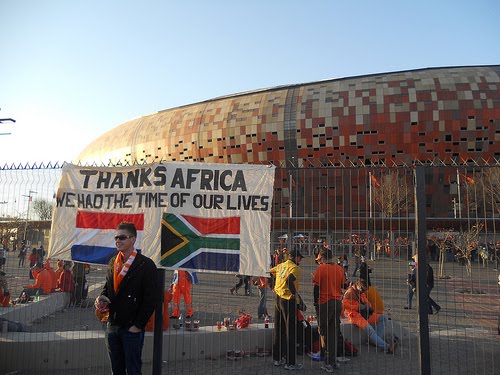
Oh, and let's not forget the Fan Walk in Cape Town, a two and a half kilometre 2.5km vaudeville show from the centre of town to that beautifully elegant Coco Chanel hat of a stadium, along which the massed hordes, thousands of children included, were bursting with bonhomie - so much so that for the semi-final on Saturday the love in the air breathed unexpected life into the sails of old Holland.
The long-buried historical connection with the Dutch (Jan van
Who?) suddenly surfaced in the Mother City in a riot of orange. I went up to one orangeman and woman after another, a number flying Dutch flags, and, to my astonishment, all the ones I spoke to turned out to be South Africans.
They were happy Holland won, not least because they avenged Uruguay's unspeakably cruel victory over Ghana. But what they were happiest about was, I think, that they had recla
imed the streets. Save for the odd case of pickpocketing (you get them in Vienna), nothing to fear.

I have a theory - I actually had it, rather more wishfully, before the World Cup - that the criminal classes would go on a patriotic strike during the tournament, doing their bit for Brand SA.
Whether that was it, or whether it was a pragmatic calculation that what with the
emergence of these swift and severe World Cup courts and the flooding of World Cup venues with the men and women in blue it might be best to keep their heads down, the fact is that the country has been more relaxed and at peace than it has been for a long time - maybe ever.

Actually, to be seriou
s, huge credit has to be given to the police. I came across loads all over the country and they were, without exception, polite and efficient, oozing civic responsibility. One that I met off duty in a bar in Bloemfontein sang me a symphony of racial brotherhood, banging on - in his cups, a little - about how South Africa was a piano. The black and white keys had to play together, he said, or not at all.
Obviously we'll have to see if all this lasts after the World Cup is over. Enough people have vented their views on this already and there is not much more to add.


Though it will be intriguing to see if the police turn out to be as assiduous in protecting the foreign Africans here, against whom murder and mayhem is threatened (especially in jolly old Cape Town), after the final whistle blows on Sunday night, as they have be
en in keeping the rather more welcome World Cup visitors safe. We'll have a test case right there of whether it's all been a dream or not.
Which brings us to the first lesson of this World Cup: the primary purpose of government is to protect its citizens. Well, let's absorb that thought and act on it. Sustain the good work that's been done after the show is over and watch this country go.

The second lesson, not at all unrelated to crime, is that if South Africa really puts its mind to something, it can do it, it can make a plan. Fifa has got a pretty bum rap from people in this country for its autocratic ways, but the Swiss-Germanic rigour that's flowed from Zurich has definitely sharpened up levels of efficiency and organisation round here, not to say - the big South African "d" word - of delivery.
Someone who works high up in the Local Organising Committee told me how at first it had been a big culture shock to work with these Swiss; they did not understand each other at all. But in time they established a rapport and the fusing of African ebullience with old European discipline ended up doing the job admirably.

The big lesson I take away from all this is one that I already knew but had forgotten, amidst the distracting babble we read about in the press and , hear and see in the broadcast media from the political classes, chatterers and newspaper columnists.

South Africa is much better, brighter and bigger-hearted than you'd think from paying attention to all that lot. The society is great, and it is the reason why (never mind the safari parks and the fairest Cape) so many of us foreigners who've spent time here find this country more beguiling than any other on Earth. Ordinary people have so much more wisdom, grit, resilience, invention, courage and generosity than you find in most countries.

And some of these ordinary people are to be found, for sure, in the ANC. Even in the upper reaches of the government, if you look hard enough. There are the looters, the hypocrites and the frauds, too, as we all know. We can just hope that the experience of the World Cup might have awoken their better angels, brought out the good that lurks in many of them, that sparked their commitment to politics in the first place.

Failing that, as a friend here says, let's pray that they remain content with taking just five or 10 percent of the national cake, instead of 30 percent or the full damn monty.

Your Julius Malemas - and I use him as a generic term for all that's rotten and silly about the South African political scene - are best ignored. Or rather, friends in the media, try, if you can resist the temptation,
not to publish and broadcast what he says. Delve deep, rather, into what he and his like do.
As for Zuma, he is a nice guy and has many of the best instincts of the best South Africa. The problem is that he lacks
gumption and sexual maturity. Not much we can do about the latter, but maybe we can prod him to show a bit of principle and character and lead the ANC back to what it once was, abandoning its lootocratic ways. A leader must not be a jellyfish, said PW Botha. Heed those words, Mr President.

Though, perhaps, he won't. In which case, let's take comfort in the knowledge that the country is, I repeat, bigger and better than the state.

If the state does not get in the way, if it actually helps, as it has done with this World Cup (notably the policing, but also the building of infrastructure) then great.
If not, well, South Africans have it in them to make a plan. The big message from this spectacularly successful staging of the greatest show on Earth is that, yes, South Africa can.
Now, with more confidence and pride and calm than ever before, get on and do it.

* John Carlin was the correspondent for the London Independent in South Africa between 1989 and 1995. He has returned to South Africa frequently since then, including nine times in the past 18 months, chiefly to work on television documentaries. He wrote Playing the Enemy, the book on which the Clint Eastwood film, Invictus, is based. The book has been translated into 16 languages, including Spanish and Dutch.

Photo Credits: http://www.shine2010.co.za